Protection of Information and Ethical Technology Use

What started as a graduate research assignment became an award-winning exploration of information protection, digital citizenship, and the ethical use of technology in education.

The Project

During my Issues in Technology Integration course at Western Governors University, I was challenged to explore information protection and the ethical use of technology in education. The assignment had two components: research and write a paper examining information protection within an educational setting and create a visual resource addressing ethical technology use.

I chose to connect the project directly to BrightBel, the fictional learning environment I was developing for my Master of Education capstone. This gave me an opportunity to consider these issues within a realistic instructional context, where adult learners would be sharing personal and professional information while participating in a fully online course.
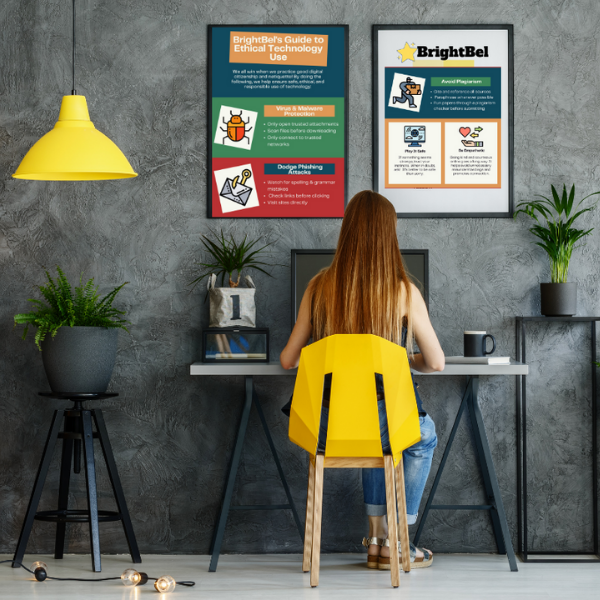
A woman with long, red hair sits at a computer on a yellow chair. On the wall are two frames containing the BrightBel Guide to Ethical Technology Use.

The Process

My research examined how learner information should be protected within an online learning environment, including ethical and legal considerations around confidentiality, data security, and technology use.

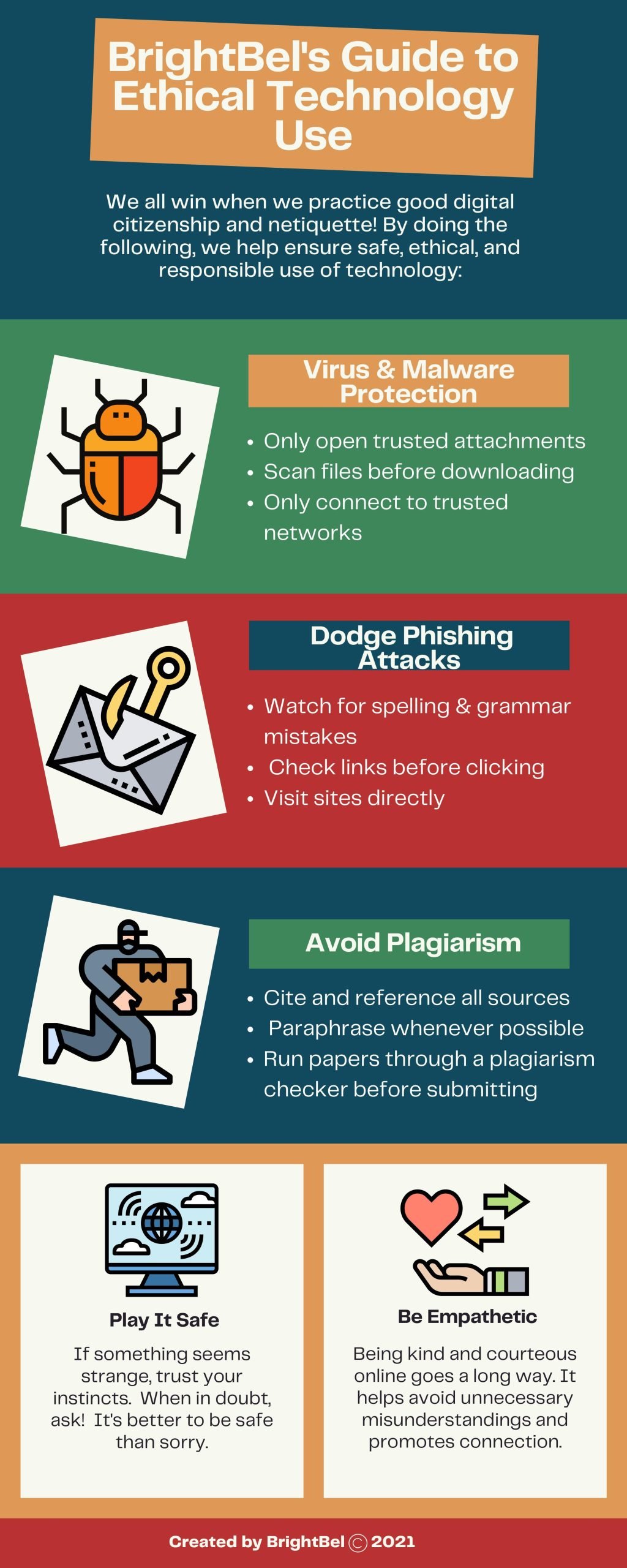
For the visual component, I created an infographic in Canva under BrightBel, the fictional brand I developed for my capstone course. I'm generally not a huge fan of infographics—they can quickly become busy and contribute to cognitive overload—so I intentionally kept the content focused, using short, practical guidance supported by simple visuals.


"An outstanding submission about the ethical concerns requiring attention when using technology. A stellar, attractive, informative, eye-catching posterlike graphic effectively and accurately communicates the guidelines for using technology."

Western Governor's University, Master of Education evaluation faculty

The Result

The project earned a Western Governors University Excellence Award, which recognizes exemplary work identified by evaluation faculty. The evaluator specifically highlighted both the strength of the ethical technology content and the infographic's ability to communicate the guidance effectively.

Together, the two deliverables demonstrate different approaches to communicating the same broader subject: the research paper provides a deeper examination of learner confidentiality, privacy, data security, and ethical technology use, while the infographic distills related concepts into practical, easy-to-scan guidance.

Both the infographic and complete research paper are included below.

Excellence Award
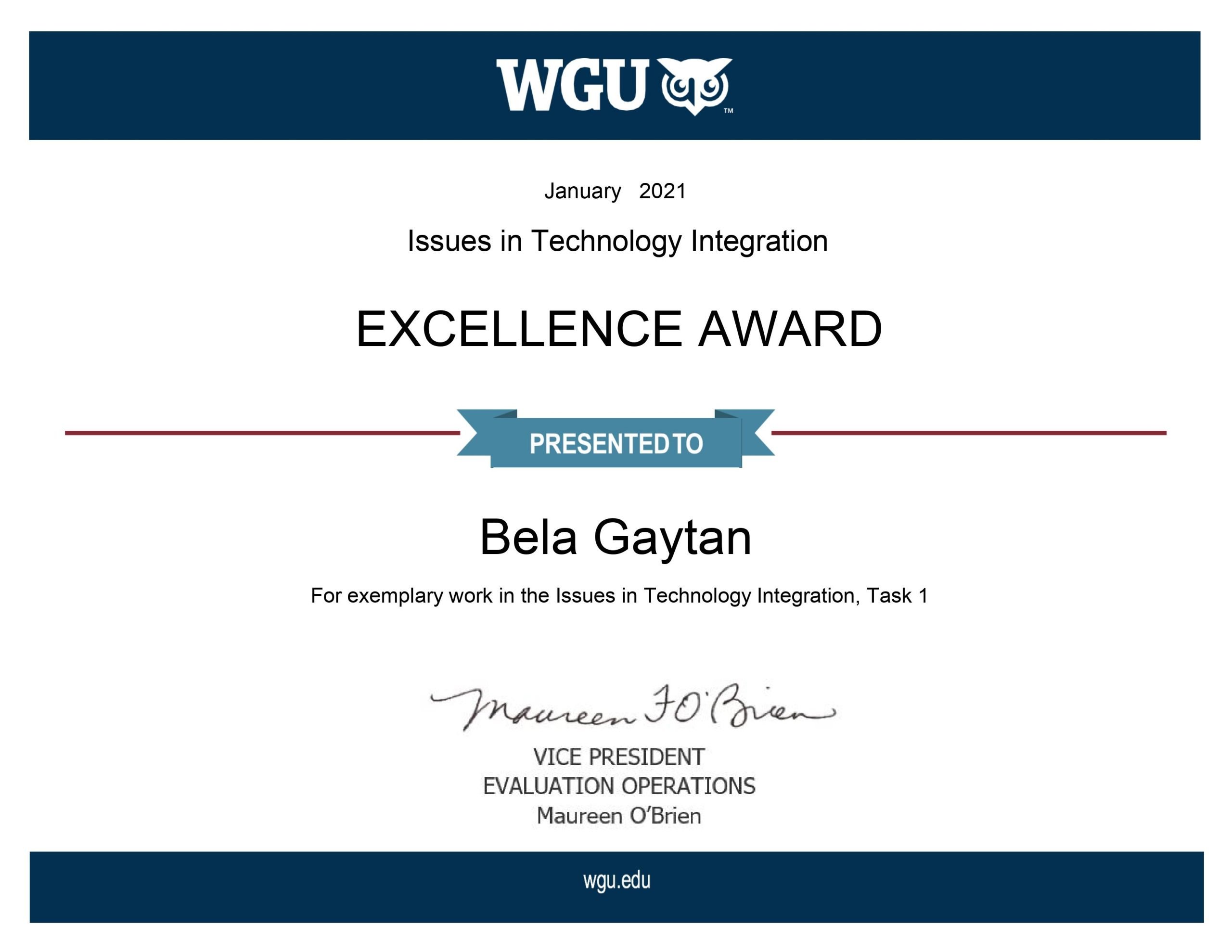
A certificate from WGU for January 2021, Issues in Technology Integration Excellence Award presented to Bela Gaytan”.

Ethical Technology Use

BrightBel’s Guide to Ethical Technology Use infographic. The words are in white letters with an orange background. The document is color-blocked with information on virus and malware protection, dodging phishing attacks, avoiding plagiarism, playing it safe online, and being empathetic.

The Research

Protection of Information

Instructional Setting, Learners, and Content

The lesson will be delivered via an online teaching platform utilizing audio, video, graphics, and file downloads. As this course is self-paced, fully online, and asynchronous, learners will participate on their own, as well as with the option to actively engage in the course forum. They may choose to attend a live webinar for synchronous participation and feedback. Offering the course completely online and asynchronously offers flexibility and accessibility to the learners. This will especially be helpful for those with differing abilities and health issues or those with work or home schedules that would typically conflict with standard hours.

The learners are adults of all ages (though typically will be aged 18-65) and are not restricted to a specific gender. The learners will be diverse and inclusive of various cultures, abilities, socioeconomic status, and marginalized groups. The motivating force behind the learners will be the opportunity to improve their chances of applying for jobs. I think the learner attitudes will vary towards the topics of resume optimization, due to lack of understanding on the topic and Applicant Tracking Systems, to having an outdated view on resumes and the older model of job application practices.

The course content will teach learners to create ATS-friendly master resumes and cover letters targeted to specific jobs and job types. They will learn the purpose of resumes, gather and organize relevant resume content, and create master resume and cover letter templates. They will further learn how to customize their resumes and cover letters for specific jobs or job types and how to optimize their resumes using an online resume scanning tool.

Ethical Reasons for Maintaining Confidentiality

As the course is focused on resume optimization, it is likely that the learners are considering a new job at some point. It could be extremely problematic if their participation in the course was not kept confidential, especially to their current employers. This could cause issues with their job, confrontations with management or other employees, and an uncomfortable work environment.

When the learners submit assignments and projects within the course, they will be sharing a lot of personal information. This will include their address, phone number, e-mail, education, places and dates of employment, and so on. All this information, if left unprotected, could make the individual very vulnerable to hacking, phishing, and identity theft.

Legal Reasons for Maintaining Confidentiality

Most websites collect personal data from users who visit the site. Information may be gathered by newsletter opt-in, surveys or questionnaires, or more so behind the scenes. Various plug-ins and third-party apps on websites gather personal details for the purpose of relevant ad offerings, analysis of traffic, and more. Although the U.S. does not have a federal law mandating the need for privacy policies to be in place, there are several laws at both the federal and state levels that require websites to have and use a privacy policy (Free Privacy Policy, 2020). The California Consumer Privacy Act (CaCPA) is one such law. The European Union abides by the stricter General Data Protection Regulation (GDPR) for its privacy laws. To cover all bases legally, it is best to have a privacy policy in place to ensure that all users and learners are aware of how their data may be used and so they may legally opt-out.

The financial information of learners must also be kept confidential for legal reasons. Students paying for courses must enter their payment information, such as debit cards, credit cards, checking accounts, or PayPal information. Breeches of this confidential information could be used to steal the identity of learners or for fraudulent spending on their accounts. The Payment Card Industry Data Security Standard (PCI DSS) is a set of security standards that all companies, regardless of size, must adhere to when accepting, processing, and transmitting credit card information (ControlScan, n.d.). Ensuring PCI compliance is not required under federal law, but several states directly reference in in their laws, such as Nevada (Justia Law, n.d.).

Confidentiality Maintenance

In my instructional setting, BrightBel, we will have a very clear privacy policy on the website. It will be updated anytime new technology is added to the site or any information changes. Using SSL encryption, we will securely handle all data coming in and out of the site. We will only utilize payment processing systems that are PCI compliant to ensure secure handling of all financial information. Student records will be managed to make every attempt at protecting student data. Security measurements such as limiting access to sensitive information, using encrypted cloud service providers, staying on top of routine maintenance, and layering network security will be in place and continuously reviewed (Nichols, 2019).

References